
The rules of CPG AI decision making are changing.
Volatile demand patterns, inflationary pressures, retailer complexity, supply chain disruptions, and shifting consumer behavior have made legacy operating models increasingly ineffective. The old playbook of siloed teams, fragmented data, backward-looking reporting, and manual decision making is breaking under the pace of today’s market.
At the same time, AI has created both enormous opportunity and significant confusion.
Many organizations are still experimenting with disconnected pilots, point solutions, dashboards layered with Generative AI, and isolated use cases that promise transformation but rarely change how decisions are actually made. While these efforts may drive incremental gains, they are not transformation. Wrapping an LLM around fragmented data and disconnected analytics does not create competitive advantage.
But the organizations we work with increasingly see this moment of disruption as opportunity.
They recognize that while much of the market is overwhelmed by vendor noise, fragmented systems, and experimentation at the edges, there is a chance to fundamentally redesign how commercial decisions are made. Rather than starting over, they are connecting what matters: trusted data, connected applications, and faster decisions across the business.
This is the shift underway in modern CPG: moving from isolated systems and reactive reporting toward intelligent, integrated decision environments capable of turning data into action at speed.
The result is not simply more analytics.
It is better decisions, made faster.
Table of Contents
ToggleThe New Operating Model for CPG
The organizations we work with are not treating AI as another software feature layered onto existing workflows. They see the disruption underway as an opportunity to redesign how commercial decisions get made.
Instead of solving pricing, forecasting, trade promotion, assortment, and supply planning independently, they are building connected systems where decisions reinforce one another across customers, brands, and channels.
This shift starts with a simple realization: AI is only as effective as the capablities of the operating systems around it.
Without trusted, harmonized data, connected workflows, explainable recommendations, and execution pathways into the business, even sophisticated models become little more than expensive reporting layers.
So what does transformation actually look like?
1. Harmonized, Always-Ready Data Infrastructure
Everything starts with decision-grade data.
The organizations we work with are building unified environments that connect the signals required to run modern commercial operations: retailer POS, syndicated data, shipment and TPM data, pricing, supply chain, manufacturing, inventory, financial data, customer-specific inputs, and broader market signals.
Critically, this is not static data warehousing. These environments refresh dynamically based on the cadence of each source system, creating an always-ready decision layer where information is current, connected, and usable.
The objective is simple: eliminate latency between signal and action. Because bad, incomplete, or delayed data is one of the fastest ways to undermine trust in AI.
2. Connected Applications, Not Disconnected Tools
Most organizations still make decisions within relatively narrow areas of responsibility. Pricing teams optimize pricing. Demand planners forecast demand. Trade teams manage promotions. Category teams manage assortment. Finance measures outcomes. Even within large portfolios, individual brands are often managed against their own objectives, with limited visibility into broader enterprise tradeoffs.
The challenge is that markets do not operate that way. A pricing change impacts promotional effectiveness. Promotions influence demand forecasts. Assortment decisions affect retailer execution, supply chain complexity, and financial outcomes. Decisions that appear rational for a single brand, customer, or function can create unintended consequences elsewhere in the organization.
The organizations we work with are moving away from disconnected point solutions toward integrated applications that connect forecasting, pricing, trade promotion optimization, assortment, decomposition, and scenario planning within a common decision environment.
What many organizations still experience as complexity, leading teams increasingly see as leverage: the opportunity to connect decisions across brands, customers, functions, and channels, reducing friction and moving materially faster than competitors optimizing in isolation.
This creates something fundamentally different than better reporting. It creates connected commercial intelligence.
3. Optimization Grounded in Business Reality
Transformation is not about surfacing more charts. It is about helping teams make better decisions in increasingly complex environments. The next generation of commercial systems optimize across multiple business realities simultaneously, balancing factors such as:
– Margin and profitable growth
– Price elasticity and price-pack architecture
– Promotional effectiveness and trade spend efficiency
– Retailer strategies and joint business priorities
– Supply constraints and manufacturing realities
– Inventory, fill rates, and service levels
– Category incrementality and cannibalization risk
Most importantly, these systems optimize within business-defined rules rather than theoretical outputs. Because the best recommendation in the world is worthless if the organization cannot operationalize it.
4. Cross-Functional Decision Alignment
One of the biggest hidden costs in CPG is organizational friction. Commercial, finance, supply chain, sales, category, and customer teams often operate from different assumptions, incentives, and datasets, slowing execution and creating conflicting decisions.
Leading CPGs are building common intelligence layers that align teams around shared recommendations, transparent tradeoffs, and common business priorities.
This matters because speed compounds. Organizations that align decisions faster increasingly turn volatility into competitive advantage, moving faster across customers, brands, and channels than teams still debating disconnected spreadsheets.
5. Faster Loops from Data to Action
Perhaps the most important shift is what happens after recommendations are made. Historically, analytics ended with a dashboard or a PowerPoint. Tomorrow’s operating models compress the distance between signal, recommendation, planning, and execution.
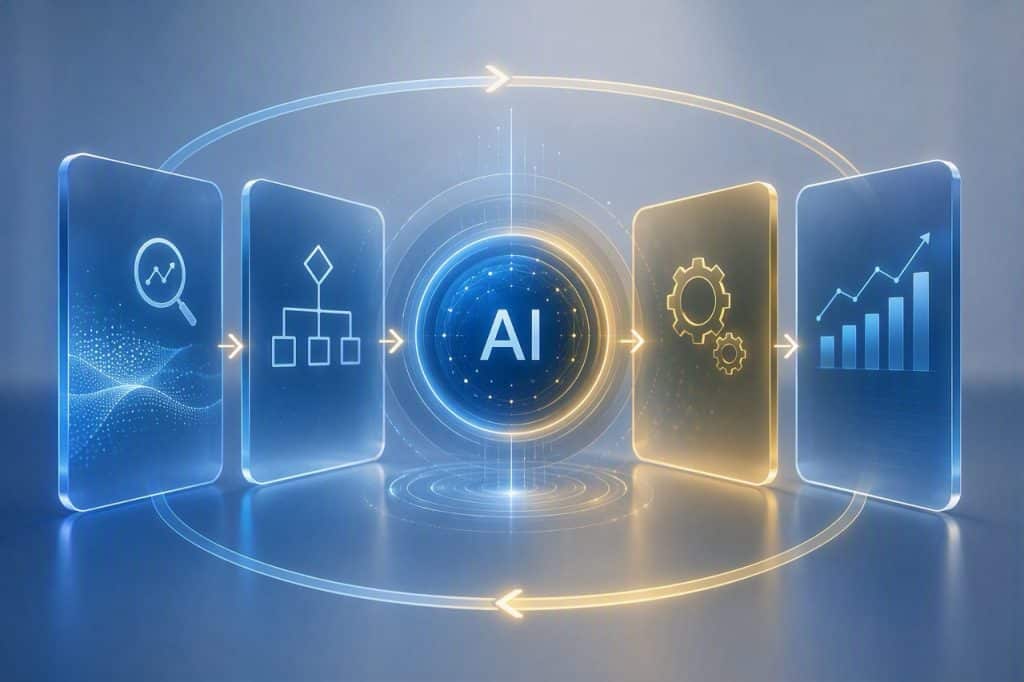
Optimization increasingly feeds directly into planning systems, workflows, and execution processes, accelerating the cycle from data → decision → action. This enables organizations not only to react faster, but increasingly to anticipate change, get ahead of the pace of the customer, and create faster learning loops across the business. Over time, it also establishes the foundation for increasingly automated decision making.
The Path Forward
The confusion surrounding AI in CPG is real. But so is the opportunity.
Leading CPGs are proving there is a path forward: connect what matters, establish trusted decision-grade data, integrate commercial intelligence across functions, and shorten the distance between insight and execution.
The future will not belong to organizations with the most dashboards, the loudest AI messaging, or the greatest number of disconnected pilots. It will belong to organizations building systems that help teams make smarter decisions and act faster.
At Insite AI, this is the transformation we help organizations build every day: connecting data, intelligence, optimization, and execution across pricing, promotions, assortment, forecasting, and planning.
Because the future of CPG is not better reporting…
It is better decisions, made faster.