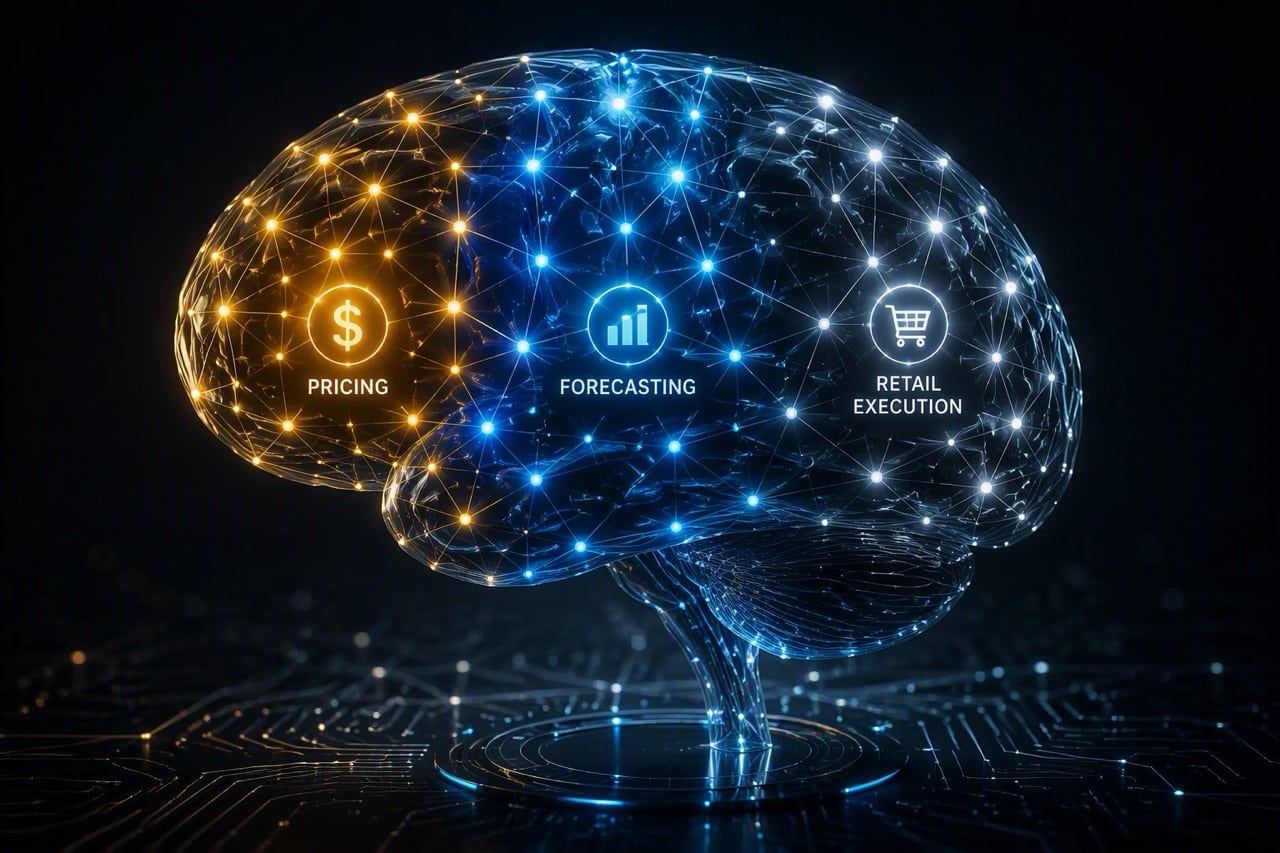

The Whole Is Greater Than the Sum of Its Parts.
Over the past two decades, commercial technology has experienced an explosion of innovation. Forecasting platforms became more sophisticated. Pricing solutions became more precise. Trade Promotion Management matured. Assortment optimization evolved. Retail execution became increasingly data-driven. Cloud data platforms unified enterprise information. Artificial intelligence accelerated capability development and promised novel, real-time insights.
Each innovation solved an important problem, and collectively, they transformed how commercial organizations operate.
Yet despite this unprecedented investment in technology, many organizations still struggle with the same fundamental challenges. Commercial planning remains fragmented. Decisions move slowly between teams. Recommendations are debated more than executed. Valuable insights exist throughout the organization, yet they rarely converge into coordinated action. Technology has become significantly more capable, but commercial operations have not become proportionately more intelligent.
The assumption has largely been that enough technology, properly integrated, would eventually solve the problem.
It hasn’t.
Table of Contents
ToggleThe Limits of Functional Software
The reason is surprisingly simple.
Enterprise software has historically been designed to support functions, not outcomes. Forecasting systems help planners forecast demand. Pricing platforms help Revenue Growth Management teams optimize pricing. Trade Promotion Management systems manage promotional planning. CRM platforms support customer engagement. ERP systems manage enterprise resources. Every application was designed around a specific discipline, a specific workflow, or a specific team.
That approach made perfect sense when organizations themselves operated largely within functional boundaries. But today’s commercial environment looks very different.
Pricing decisions immediately influence demand. Demand reshapes forecasts. Forecasts affect supply planning. Supply influences customer commitments. Promotions change profitability. Assortment decisions reshape consumer behavior. Every commercial decision creates consequences across multiple functions simultaneously.
The organization has become interconnected but the the software has not.
Most commercial technology still mirrors the organizational chart rather than the commercial system itself.
The challenge is no longer optimizing individual functions – it is orchestrating them.
Integration Isn’t Intelligence
Recognizing this fragmentation, organizations have spent years investing in integration. APIs connect applications. Data platforms centralize information. Middleware synchronizes systems. Dashboards consolidate reporting. Modern architectures have dramatically improved the movement of data across the enterprise.
These investments have created enormous value, but they have also exposed an important distinction: connected systems are not the same as intelligent systems.
Moving information between applications does not create commercial reasoning. A pricing engine does not understand supply constraints. A forecasting platform does not understand retailer negotiations. A CRM system does not evaluate promotional effectiveness. Even when every application shares the same underlying data, each continues to optimize only its own portion of the commercial process.
Integration solved the problem of connectivity but it did not solve the problem of coordination.
Commercial Intelligence Requires a Center
Every successful enterprise platform has provided a center of gravity for its domain.
- – ERP became the system that coordinated enterprise resources
- – CRM became the system that coordinated customer relationships
- – Cloud data platforms became the system that coordinated enterprise information
Commercial operations have never had an equivalent.
Instead, commercial intelligence has been distributed across dozens of applications, teams, consultants, spreadsheets, and planning processes. Every participant contributes valuable expertise, but no single system continuously reasons across pricing, forecasting, promotions, assortment, customer planning, financial outcomes, and execution as one interconnected commercial system.
That is the gap organizations are increasingly trying to solve. Not by replacing every existing application, but by introducing a system capable of reasoning across all of them.
A Commercial Intelligence System does not compete with forecasting software, pricing engines, CRM platforms, or ERP systems. It depends on them. They remain systems of execution and systems of record. The Commercial Intelligence System becomes the layer that continuously evaluates the interactions between them, identifies tradeoffs, recommends coordinated actions, and improves as new outcomes are observed.
Its responsibility is not to optimize a function. Its responsibility is to optimize revenue.
The Next Evolution of Enterprise Software
Every major shift in enterprise software has followed a familiar pattern. The first generation digitized manual work. The second standardized processes. The third connected information across the enterprise. The next generation will coordinate enterprise intelligence.
Organizations will continue to invest in forecasting, pricing, retail execution, ERP, CRM, and cloud data platforms because each serves an essential purpose. But competitive advantage will increasingly come from the system that connects those capabilities into a continuously learning commercial operating model.
The future will not belong to the organization with the most software – it will belong to the organization whose software reasons together.
At Insite AI, we believe Commercial Intelligence Systems represent that next evolution. Not because they replace existing enterprise applications, but because they finally enable them to operate as parts of a single commercial system rather than a collection of independent optimizations.
The future of commercial operations isn’t built by adding another point solution. It’s built by giving the entire enterprise the ability to think as one.