
There is a pattern in how technology companies build durable competitive advantage. They do not simply build the best tool. They progressively acquire ownership of the entire experience their tool is meant to improve — until replacing them means replacing not just software, but an entire operating model.
Apple did not win by making great hardware. It won by controlling the chip, the device, the software, the distribution, and the service layer. Zara did not win by making great clothes. It won by controlling design, manufacturing, distribution, and retail under one roof. The pattern is consistent: the most defensible market positions belong to companies that close the loop.
In CPG commercial intelligence, the loop is not yet closed. And that gap represents one of the largest untapped opportunities in the industry.
The Intelligence-Execution Gap
The CPG industry has invested heavily in AI over the past three years. According to McKinsey’s 2024 survey of CPG leaders, 71% reported adopting AI in at least one business function — up from 42% the year before. (Source: McKinsey Global Survey on AI, 2024) Platforms are multiplying. Budgets are moving. The technology is real.
And yet, the execution layer — the sales brokers, field teams, key account managers, and trade services providers that sit between a CPG brand and a retailer’s buying decisions — largely still operates the way it always has. Relationship-driven. Quarterly-cadenced. Spreadsheet-dependent.
This creates what we call the intelligence-execution gap. The AI platform recommends an optimal price adjustment at a specific retailer. A category manager receives the insight, agrees with it, and then routes it through a sales broker who presents it in a deck at a quarterly business review six weeks later. By that time, the market has moved, the shelf has been reset, and the competitor has already taken the space.
The data is telling the truth. The delivery system is still running on the old clock.
What “Vertical Integration” Actually Means for a CPG AI Company
The conventional technology company response to this problem is to build better integrations — APIs, connectors, dashboards for the field team. These help at the margin. They do not close the gap.
Closing the gap requires a different strategic move: acquiring and transforming the sales services companies that currently occupy the space between AI insight and retail execution, and rebuilding them as technology-first, AI-native delivery vehicles.
This is not a novel strategy in other industries. Strategy& (PwC) has documented how vertical integration in consumer markets — when pursued deliberately — allows companies to reduce costs, accelerate innovation, and build closer connections to the end customer. (Source: Strategy&/PwC, “Vertical Advantage in Food and Beverage”) The pattern from food and beverage manufacturing applies with equal force to the commercial intelligence layer of CPG: companies that control both the intelligence and the execution of commercial decisions will outperform those who only provide one or the other.
The CPG M&A landscape is already moving in this direction. EY’s analysis of consumer AI-related M&A found that deals span the entire enterprise value chain, with approximately one-fifth focused on driving sales and last-mile solutions. (Source: EY, “GenAI Reshapes CPG, Retail and Consumer Relationships,” 2024) The industry is recognizing that the value of AI is not captured at the model layer — it is captured at the execution layer.
The Four Strategic Benefits of Owning the Full Circle
- Win more customers, faster. Today, a CPG brand evaluating an AI commercial platform faces a secondary procurement decision: who implements it, who trains the team, who manages the services layer? By acquiring and transforming services companies as part of the platform offering, that question disappears. The customer gets technology and delivery from one accountable partner — and the sales cycle shortens accordingly.
- Serve customers more efficiently over time. When the services layer operates on the same AI platform it is delivering, every client engagement produces structured data that improves the models. The cost of delivery decreases as the system learns. The margin profile of the services business improves as AI replaces manual process. This is the compounding flywheel that pure services companies can never access — and that pure software companies can never sustain without owning the execution layer.
- Become genuinely sticky. Software vendors get replaced. Operating infrastructure does not. A CPG brand can evaluate a new pricing platform in a quarter. It cannot unwind an AI-native services relationship that is embedded in how its field teams operate, how its promotions are planned, and how its retailer relationships are managed — without significant disruption. Stickiness built at the operating model level is structurally different from stickiness built at the feature level.
- Make measurably more impact at the shelf. The ultimate measure of commercial intelligence in CPG is not dashboard engagement or model accuracy. It is whether a product is on the right shelf, at the right price, with the right promotional support, in the right store, at the right time. That outcome only happens when the entity that generates the intelligence also controls the execution that acts on it. Owning both sides of the equation is the only way to close the accountability loop entirely.
Technology-First, Not Technology-Adjacent
The critical distinction in this strategy is the word “first.” Acquiring a sales services company and layering technology on top of it produces a services company with a software subscription. That is not the goal.
The goal is to acquire services companies and rebuild them from the inside out as technology-first operations — where the AI platform is not a tool the team uses, but the system through which every commercial decision is made, executed, and measured. Human judgment remains at the governance layer. AI operates at the execution layer. The services company becomes, in effect, a managed AI delivery vehicle.
This is the model that the most sophisticated CPG technology players are beginning to pursue. Engine’s April 2026 merger with Nuqleous — creating a unified platform spanning retail data, analytics, and shelf execution — reflects the same underlying thesis: CPG companies cannot afford to stitch together point solutions, and the companies that replace that patchwork with end-to-end AI-enabled execution will define the next competitive era. (Source: PR Newswire, “Engine and Nuqleous Complete Strategic Merger,” April 2026)
The Insite AI Vision: A Closed Loop for Commercial Intelligence
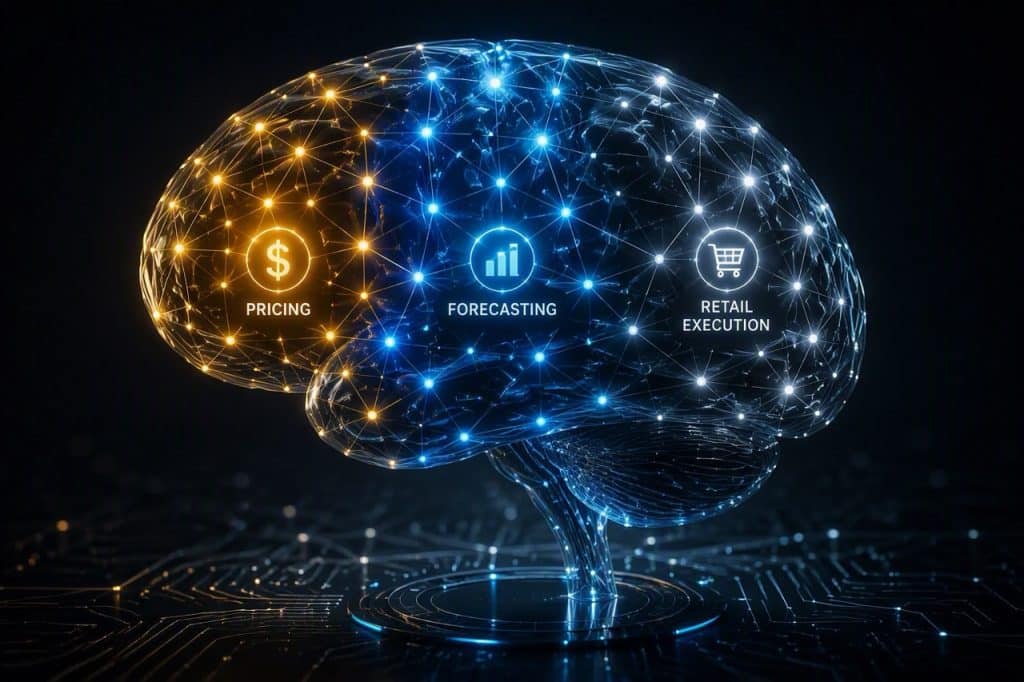
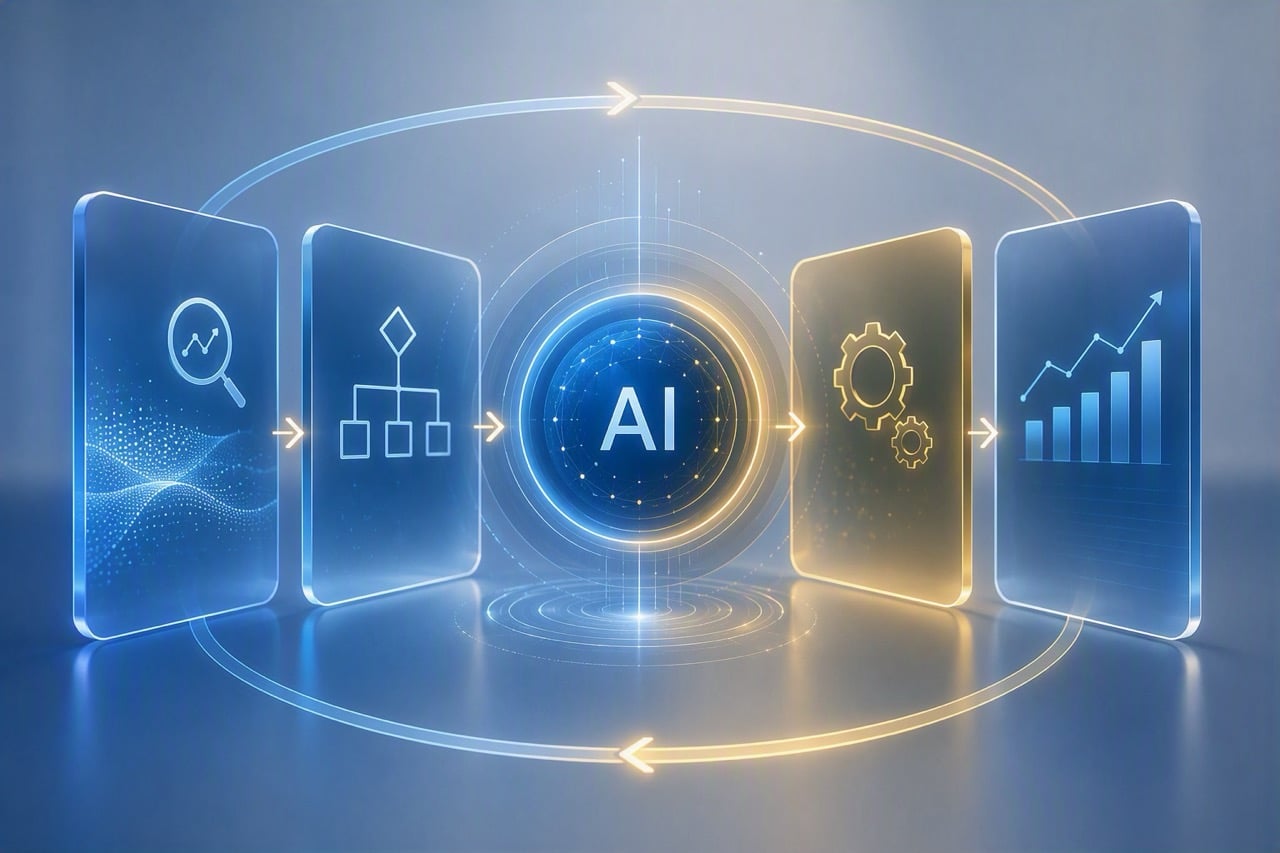
At Insite AI, our core belief is that AI Revenue Under Management — the concept that AI should not just recommend commercial decisions but execute and optimize them continuously — requires owning the full circuit from data to decision to shelf outcome.
That means the platform. The data foundation. The commercial logic layer. And increasingly, the services delivery vehicle that puts that intelligence into the hands of the people and systems that determine what ends up on the shelf.
The CPG brands that will build durable commercial advantage over the next five years are not the ones with the best data or the most sophisticated models. They are the ones whose commercial operating model — from pricing architecture to field execution — is AI-native at every layer.
The full circle is not a product feature. It is a strategic position. And it is the position Insite AI is building toward.