
The next generation of enterprise software won’t just record commercial activity. It will continuously improve it.
Over the past forty years, enterprise software has transformed nearly every function inside the business. ERP systems gave organizations control over finance, inventory, procurement, and operations. CRM platforms transformed how companies managed customer relationships. Business intelligence platforms helped explain what happened. Cloud data platforms centralized enterprise information at unprecedented scale.
Each generation solved an important problem, but they all shared one characteristic – they primarily helped organizations record, organize, and understand their business.
Commercial operations have followed a different path. Revenue, the single most important outcome for most organizations, is still managed through dozens of disconnected systems, specialized teams, spreadsheets, meetings, and manual processes. Pricing teams optimize pricing. Revenue Growth Management teams optimize promotions. Category teams optimize assortment. Demand planners optimize forecasts. Sales teams manage customer relationships. Finance measures the outcome. Every function performs an important role. Yet no system is responsible for continuously improving revenue as a whole.
Table of Contents
ToggleThe Limits of Functional Optimization
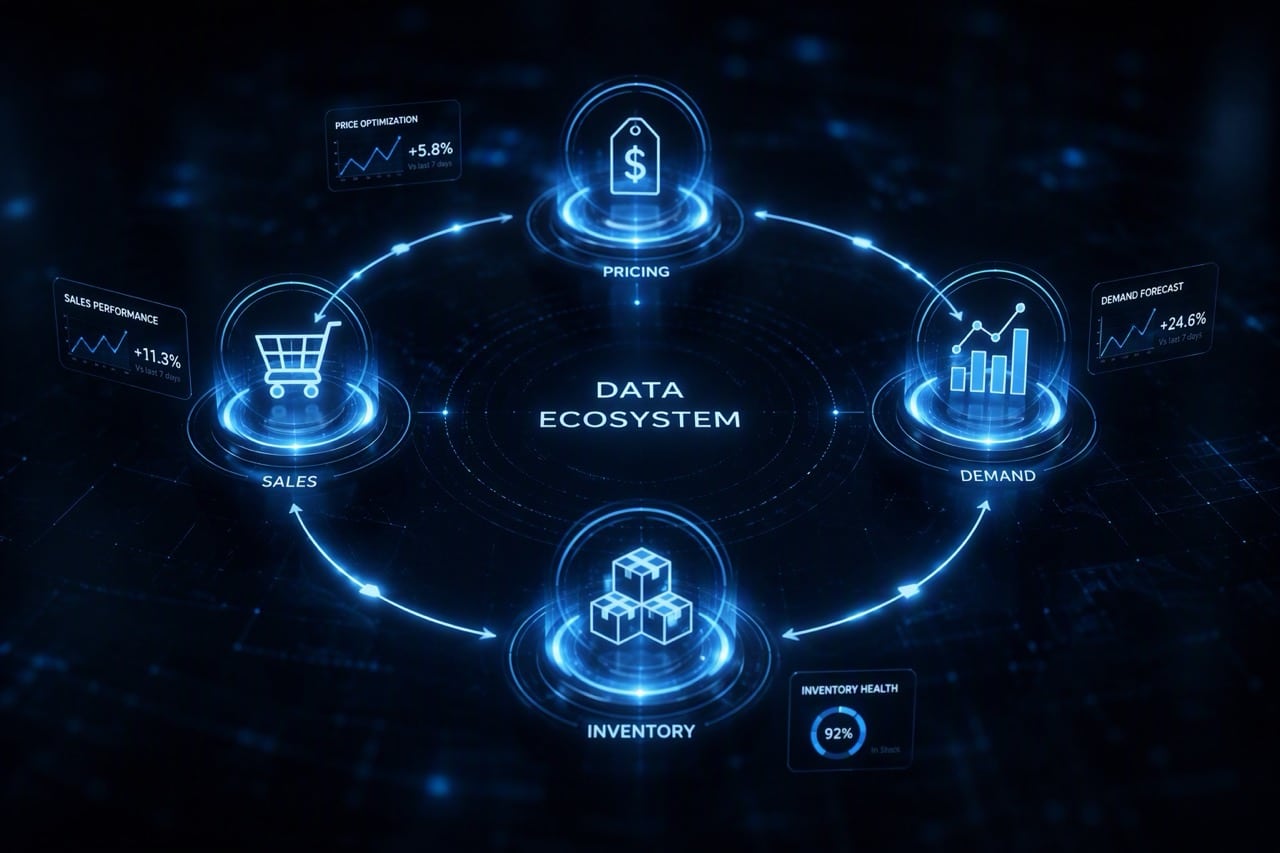
For years, this operating model was good enough. Commercial decisions were slower, markets changed less frequently, and planning cycles were measured in quarters, not days. But that world no longer exists. Today’s commercial decisions are deeply interconnected; a pricing decision changes demand, demand changes forecasts, forecasts change inventory, inventory changes retailer commitments, promotional investments affect profitability, and assortment decisions reshape consumer behavior – all at the pace of the consumer, which has rapidly evolved.
No commercial decision exists in isolation, yet most organizations continue to evaluate and execute those decisions one function at a time. The result is exactly what you’d expect:
- • Organizations buy point solutions instead of solving business problems
- • They wait for perfect data instead of creating intelligence
- •They generate valuable recommendations but struggle to execute them quickly
- • They optimize individual functions while revenue remains fragmented across the enterprise
The challenge is no longer capability. It is architecture.
The Next Operating Model
Every generation of enterprise software has fundamentally changed how businesses operate. ERP systems standardized financial and operational processes. CRM platforms standardized customer engagement. Data platforms unified information across the enterprise. Each new generation abstracted away complexity, allowing organizations to spend less time managing information and more time managing the business.
Commercial operations are now reaching a similar inflection point.
The next evolution will not be another forecasting application, another pricing engine, or another planning tool. It will be a fundamentally different operating model – one where commercial decisions are no longer treated as isolated activities owned by individual functions, but as connected events within a continuously learning system. Forecasting influences pricing. Pricing influences promotions. Promotions influence demand. Demand influences supply. Supply influences customer commitments. Every decision becomes both an output of previous intelligence and an input into future intelligence.
The process no longer begins with planning and ends with reporting. Instead, it becomes a continuous cycle of observation, reasoning, execution, and learning. The objective is no longer simply to make a better decision today. It is to ensure every decision makes the next one better.
From Systems of Record to Systems of Intelligence
Today’s enterprise is built on systems of record. ERP systems record financial transactions. CRM platforms record customer interactions. Retail systems record sales. Supply chain systems record inventory movements. Cloud data platforms have dramatically improved the ability to centralize and organize this information, giving organizations an increasingly complete picture of what has already happened.
The next generation of enterprise software will serve a different purpose.
Rather than recording the business, it will continuously improve the business. Instead of simply organizing information, it will reason across that information, generate recommendations, coordinate actions, observe outcomes, and refine its understanding over time. The enterprise will move beyond systems that explain yesterday toward systems that actively shape tomorrow.
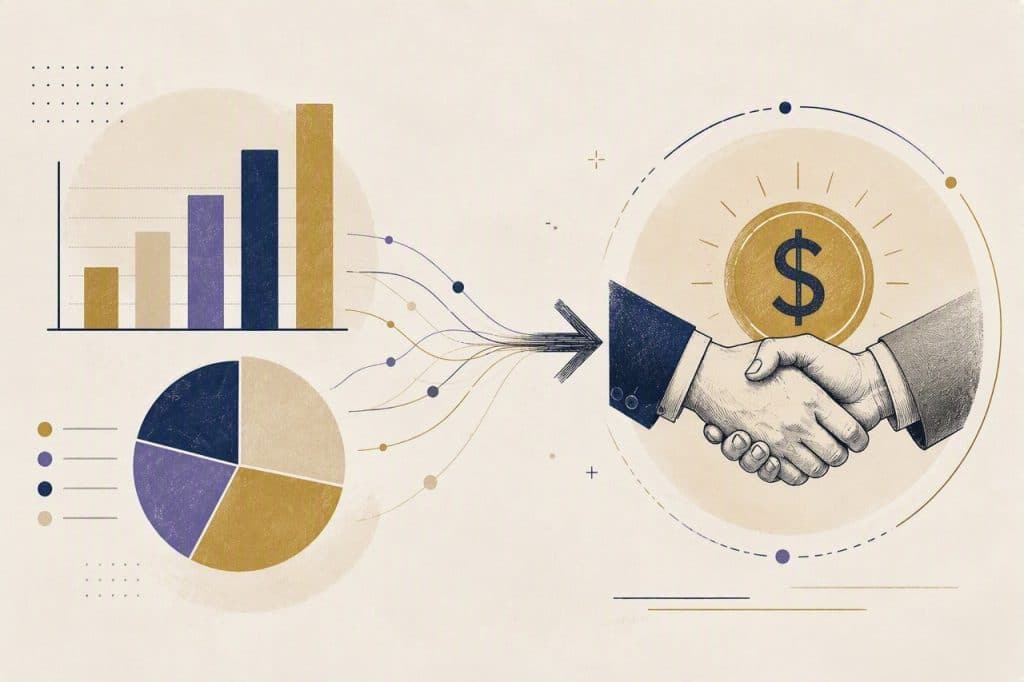
This is what we believe a Commercial Intelligence System represents. It sits between enterprise data and commercial execution, continuously transforming market signals into commercial reasoning, commercial reasoning into action, and every resulting outcome into new proprietary intelligence. Unlike traditional software, whose value remains relatively static after implementation, a Commercial Intelligence System compounds in value because every commercial decision contributes to making the system itself smarter.
The Closed-Loop Advantage
For decades, commercial organizations have become increasingly sophisticated at generating recommendations. Forecasts have improved. Pricing models have become more accurate. Promotional optimization has become more scientific. Yet once those recommendations leave the screen, the learning process often stops. Whether a recommendation was accepted, how it was executed, how retailers responded, how consumers behaved, and which assumptions ultimately proved correct frequently remain disconnected from the systems that generated the recommendation in the first place.
That disconnect has become one of the largest remaining opportunities in commercial operations.
The organizations that will lead the next decade will not simply produce better recommendations; they will build systems that continuously learn from the outcomes of every recommendation they make. Execution will no longer represent the end of the workflow but another source of intelligence. Every recommendation creates new observations. Every observation refines commercial understanding. Every refinement improves future decisions. Over time, the competitive advantage shifts from individual algorithms or models to the speed and quality with which the entire commercial system learns.
The most valuable data in the enterprise is no longer the data that was collected yesterday. It is the proprietary intelligence created every time the organization observes the results of its own decisions.
The Next Competitive Advantage
This shift represents something much larger than the adoption of artificial intelligence. It represents the next major evolution of enterprise software itself. Every previous generation has helped organizations manage resources, transactions, relationships, or information more effectively. The next generation will help organizations continuously improve the quality of their commercial decisions.
Organizations will increasingly compete not because they possess more data than their competitors, but because they possess systems that learn faster from that data. The advantage will come from connecting market signals, commercial reasoning, execution, and feedback into a continuously improving operating model. In that world, commercial intelligence is no longer delivered through isolated applications. It becomes enterprise infrastructure.
At Insite AI, we believe this is where the industry is heading. Not toward more point solutions, larger transformation programs, or disconnected AI capabilities, but toward a Commercial Intelligence System that continuously connects data, decisions, execution, and learning across the revenue lifecycle. Because the future of enterprise software will not be defined by the amount of information it stores. It will be defined by its ability to make every commercial decision improve the next one.