
Table of Contents
ToggleBuilding an Organization That Grows Smarter with Every Decision
For most of the history of enterprise technology, software has been built to preserve and organize what a company knows. ERP systems created a common record of resources and transactions. CRM organized customer relationships. Business intelligence made performance easier to understand, and cloud data platforms brought enormous amounts of enterprise information together in one place.
Each generation made businesses more informed and, in many cases, more efficient. But the basic model didn’t change much. Information accumulated, people interpreted it, decisions were made, and eventually the results of those decisions showed up as more information.
What was rarely preserved was the thinking in between.
Consider something as routine as a pricing decision. A commercial team might spend weeks considering competitive behavior, consumer response, retailer economics, financial objectives and expected demand before settling on a recommendation. An assortment decision might incorporate years of experience about how consumers switch between products. A forecast reflects assumptions about promotions, distribution, pricing and market conditions that may never appear in the forecast itself.
Months later, the organization knows the result. Sales went up or down. Margin improved or deteriorated. The forecast was right or wrong. But much of the context behind the original decision has already disappeared into presentations, spreadsheets, meetings, different applications and, ultimately, the memories of the people involved.
The outcome becomes data. Too often, the decision itself does not become institutional knowledge.
That is the opportunity we believe is now opening up in commercial technology.
From Institutional Knowledge to Institutional Intelligence
Every successful CPG has people who simply know the business. They understand how a particular retailer tends to react, which promotional mechanics are likely to work, where consumers are unusually price sensitive, how an assortment change might move demand across the category, or which early signals deserve attention before they become obvious in the financials.
Companies have always tried to capture and scale that knowledge through processes, playbooks, planning cycles and technology. Some of it transfers. A lot of it doesn’t. Experience is difficult to reduce to a workflow, and when experienced people change roles or leave the organization, some portion of what they know inevitably leaves with them.
A Commercial Intelligence System creates the opportunity to capture more of that experience—not by trying to replace human judgment, but by preserving more of the context around the decisions where that judgment is applied.
- • What did the business look like when the decision was made?
- • What alternatives were considered?
- • What did we expect to happen?
- • What did we ultimately decide?
- • Was that decision executed as intended?
- • And, once it reached the market, what actually happened?
Those questions are usually answered in different places, by different people, at different points in time. Connecting them creates something much more useful than another historical dataset. It gives the organization a growing record of how it has made commercial decisions and what it has learned from them.
Over time, institutional knowledge starts to become institutional intelligence.
The Decision at the Center of Commercial Strategy
Throughout this series, we’ve looked at many of the problems holding commercial organizations back: fragmented applications, the pursuit of perfect data, functional optimization, slow decision cycles, disconnected execution and the enormous amount of valuable commercial information that organizations create but fail to reuse.
They look like different problems, but increasingly we see them as manifestations of the same one. Commercial technology has been organized around data, applications and functions when the thing that actually determines performance is the decision.
Put the decision at the center and the architecture starts to change.
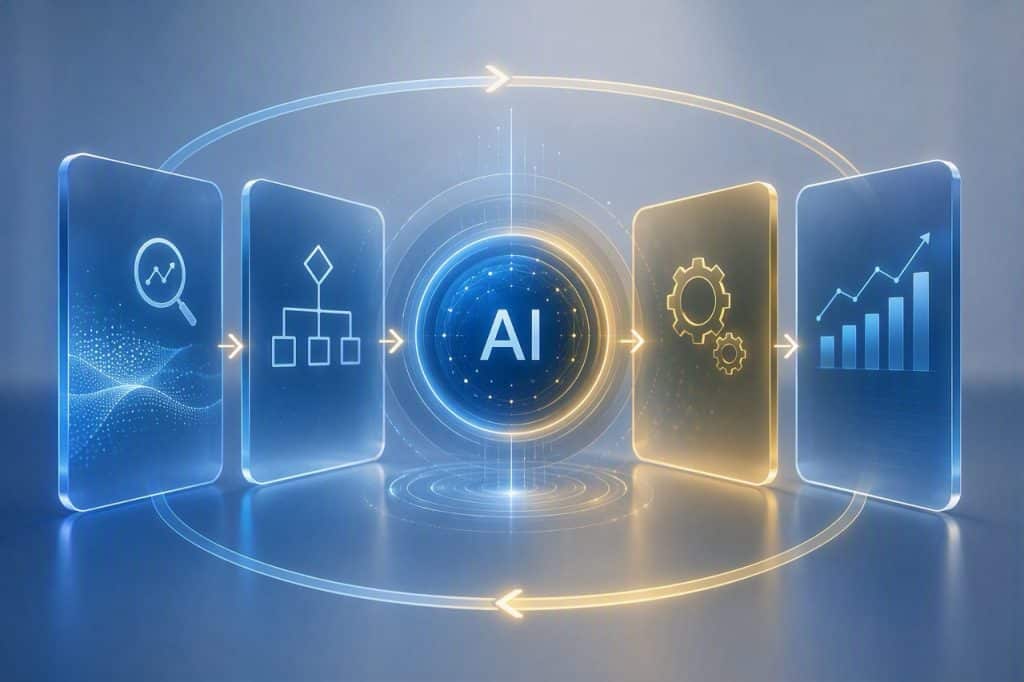
Data provides the context for what is happening. Commercial intelligence helps determine what is likely to happen next and evaluates the available choices. People bring judgment, experience, strategy and customer context to the decision. Execution puts that decision into the market, and the outcome tells the organization whether its assumptions were right.
The important part is what happens after that.
In most organizations, the process largely resets. The result flows into reporting, new data accumulates, and another planning cycle eventually begins. In a learning commercial system, the result feeds back into the intelligence that informed the original decision. The next forecast benefits from the last forecast. The next pricing recommendation incorporates what actually happened after the last price change. The next assortment decision starts with a better understanding of how demand transferred the last time.
The decision isn’t the end of the process. It becomes part of what the organization knows the next time it has to make one.
When Commercial Experience Starts to Compound
This is where we think the economics of commercial intelligence become particularly interesting.
Traditional software creates value primarily through the capability it provides. A forecasting application helps produce a forecast. A pricing application helps evaluate a price. A promotion tool helps plan an event. Those capabilities can be extremely valuable, but using them does not necessarily make the underlying system materially more knowledgeable about the business.
A learning commercial system should work differently.
Every forecast provides another observation about where expectations were accurate and where they diverged from reality. Pricing decisions refine the organization’s understanding of consumer response. Promotions add evidence about what works under different conditions, while assortment changes reveal more about demand transfer and switching behavior. Execution adds another critical dimension because the organization can distinguish between a recommendation that was wrong and one that was simply never executed as intended.
And none of these decisions really exists in isolation. Pricing affects demand. Demand affects forecasting and supply. Promotions influence baseline behavior. Assortment changes alter where demand moves. Retailer execution determines what consumers actually encounter, and eventually all of it flows through revenue and profitability.
The more of those relationships the system understands, the more valuable each completed commercial cycle becomes. A traditional dataset accumulates history. A learning system accumulates experience.
That difference compounds.
Driving Commercial Performance with Faster Decisions
None of this matters if it simply creates more analysis.
Commercial teams already have plenty of analysis. The challenge is getting enough of the right intelligence to the right decision while there is still time to do something about it.
Speed and decision quality are often treated as competing objectives. Move quickly and you sacrifice rigor; add rigor and the process slows down. Much of that tradeoff, however, is a consequence of how commercial organizations operate today. Teams spend enormous amounts of time gathering information, reconciling different views, rebuilding analyses and moving conclusions between functions before they can apply judgment to the actual decision.
Persistent commercial intelligence changes that equation. If the system is already monitoring the business, it can recognize a meaningful change before the next formal review. If it already understands the relationships across pricing, demand, promotion, assortment and financial outcomes, teams don’t need to reconstruct those implications every time something changes. And if prior decisions and outcomes remain part of the intelligence base, the organization doesn’t have to relearn the same lessons every planning cycle.
That is how speed and intelligence begin to reinforce one another rather than compete.
The goal isn’t to make decisions faster for the sake of speed. It’s to spend less time getting to the decision and more time making the decision well.
That is what we mean by Better decisions, made faster.
The Commercial Enterprise That Learns
Forecasting, pricing, promotion, assortment, customer planning and retailer execution aren’t going away, nor should they. They are different disciplines, with different expertise, and many of the most important decisions within them will continue to depend on experienced people who understand brands, consumers, customers and strategy.
What should change is how much those disciplines have to relearn independently.
A pricing decision should inform the next forecast. An assortment outcome should improve the next understanding of demand transfer. Retailer execution should tell the organization whether a recommendation actually reached the market. A promotion should create knowledge that is useful beyond the team that planned it.
The organization should get smarter simply by operating.
That’s a different ambition for enterprise software. Instead of asking technology only to store information, automate workflows or optimize individual functions, we can begin asking it to preserve and improve the commercial intelligence of the organization itself.
People remain central to that model. In fact, their judgment becomes more valuable because the system can carry more of the accumulated context into every decision. The experienced commercial leader doesn’t have to choose between relying on technology and relying on instinct; the system becomes a way to combine what the organization has learned quantitatively with what its people understand about the business.
And when people move on, the organization doesn’t have to start over.
Every Decision Should Make the Next One Better
That is ultimately where the ideas in this series have been heading.
We started with the way AI and new technology are changing commercial decision-making, but the bigger opportunity was never the technology itself. It was the possibility of changing how a commercial organization operates: connecting decisions that have historically been made in isolation, creating intelligence rather than simply consuming data, reducing the friction between insight and action, connecting execution back to the original decision, and using the resulting experience to improve what happens next.
At Insite AI, we call the system at the center of that model a Commercial Intelligence System.
Our mission is to build the world’s first one.
Not another system of record describing what happened, and not another point solution optimizing one piece of the commercial organization. A system that helps the business understand what is changing, determine what to do about it, move from decision to action faster, and retain what it learns along the way.
For decades, enterprise software has helped companies build better records of their businesses.
We think the next generation should help them build better instincts.
Every Decision Should Make the Next One Better.